
How to perceive the Ethnic Unity and Progress Promotion Law of China?
Understanding its basic attributes and distinctive characteristics

Zhang Wenxian
It is worth noting that, the Ethnic Unity and Progress Promotion Law uses firm and explicit language to prescribe clear rules for ethnic relations and ethnic work, embodying an organic integration of principles and rules as well as programmatic and normative elements.
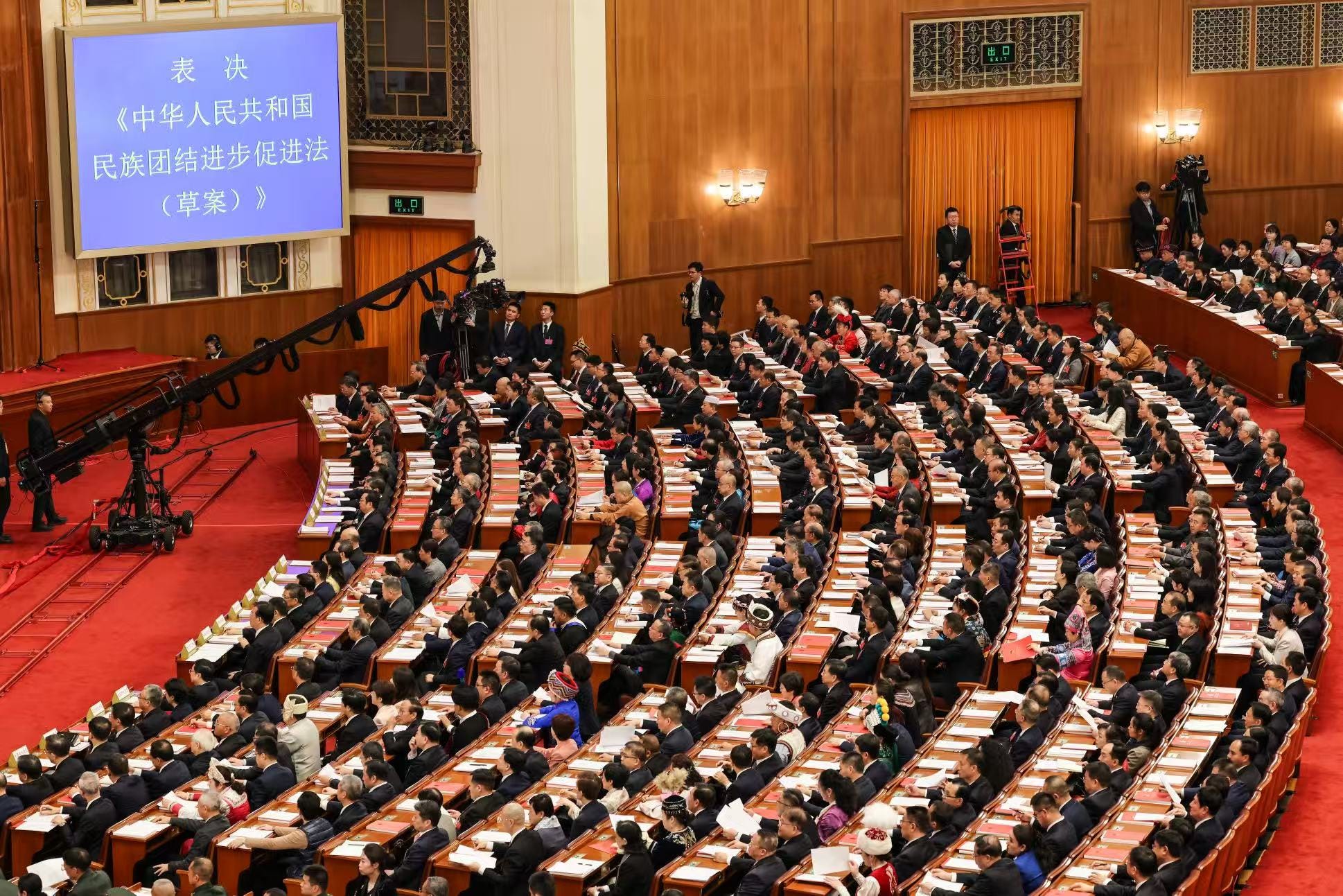
In March 2026, the Fourth Session of the Fourteenth National People’s Congress (NPC) deliberated and adopted the Ethnic Unity and Progress Promotion Law of the People’s Republic of China. This law possesses special attributes and distinctive characteristics. Using legal form and a systematic, integrated approach, it transforms China’s innovative theories, successful practices, and valuable experiences in ethnic work and governance of ethnic affairs into the will of the state and norms of conduct for all citizens.
What structure does the Ethnic Unity and Progress Promotion Law adopt?
The structural design of legislation generally refers to the arrangement and expression of legal norms in terms of form and structure, including the title of the law (or regulation), the setup of parts, chapters, sections, articles, and clauses, and the logical sequence of provisions. It constitutes an important component of legislative technique. The Ethnic Unity and Progress Promotion Law adopts a structure consisting of a “preamble and seven chapters.” Such structure highlights the specialty and importance of this law.
In China’s current legal system, only the Constitution of the People’s Republic of China, the Law of the People’s Republic of China on Regional Ethnic Autonomy, the Basic Law of the Hong Kong Special Administrative Region of the People’s Republic of China, and the Basic Law of the Macao Special Administrative Region of the People’s Republic of China have an preamble. The Ethnic Unity and Progress Promotion Law is the fifth major law that includes a preamble.
The reasons and significance for including a “preamble” in a law generally lie in two aspects: First, certain guiding and overarching historical backgrounds, realistic foundations, important theories, and basic policies closely related to the law cannot be fully expressed within the main articles. For example, the preamble to the Constitution includes content on the review of China’s history, the state’s guiding ideology, basic state policies, goals, fundamental tasks, and foreign relations—matters that would be cumbersome and unbalanced if placed in the main text. Likewise, the preamble of the Ethnic Unity and Progress Promotion Law takes the formation and development of the community of the Chinese nation as its narrative thread, emphasizing that “the Chinese nation is a diverse and unified family formed by all ethnic groups. Ethnic unity is the lifeline of the people of our country.”
Second, certain declarative, programmatic content is indispensable for correctly understanding, interpreting, and applying the law but is not suitable for inclusion as normative articles. Such content is better placed in the preamble. For instance, the Ethnic Unity and Progress Promotion Law states that realizing the great rejuvenation of the Chinese nation is the common pursuit of all Chinese people, and that safeguarding national unity and promoting ethnic unity and progress are the common responsibility of the Chinese people.
What are the main contents of the main body of a law?
The main body of the Ethnic Unity and Progress Promotion Law follows a three-part structure: General Provisions—Specific Provisions—Supplementary Provisions. The General Provisions, placed at the beginning of the statute, set out core matters—including the legislative purpose, guiding principles, scope of application, and regulatory objectives—and play an overarching and guiding role throughout the law.
The General Provisions of the Ethnic Unity and Progress Promotion Law contain 10 articles. They state that “the law is enacted in accordance with the Constitution for the purposes of promoting ethnic unity and progress, fostering a strong sense of the Chinese nation as one community, advancing the building of the Chinese nation as one community, and driving the accomplishment of the great rejuvenation of the Chinese nation.” The provisions affirm ethnic equality, unity, and progress; promote the joint efforts and common prosperity and development of all ethnic groups; and establish key principles, including upholding and improving the system of regional ethnic autonomy, administering ethnic affairs according to law, safeguarding national unity and security, and maintaining the unity and authority of the rule of law.
The Specific Provisions are organized into five chapters that establish concrete stipulations on major matters, major systems, important principles, and basic rules for promoting ethnic unity and progress. For example, Chapter III, Promoting Exchange, Communication, and Integration, specifies goals and tasks such as building integrated community environments; improving conditions in which all ethnic groups live, learn, work, and share happy social life together; fostering friendly, inclusive, and integrated communities and online platforms adapted to regional circumstances; and strengthening mutual learning and integration among the cultures of all ethnic groups. Chapter IV, Promoting Common Prosperity and Development, provides that efforts should center on achieving common prosperity and development for all ethnic groups by accelerating high-quality and coordinated regional development in ethnic areas, promoting common prosperity for all ethnic groups, coordinating development and security, and jointly safeguarding border, resource and energy, food, and ecological security.
And, Chapter VI, Legal Liability, stipulates that those who organize, plan, or carry out violent terrorist activities, ethnic separatist activities, or religious extremist activities—or who incite or finance such activities—shall be investigated for criminal responsibility in accordance with the law. Because other Chinese laws already contain specific provisions on legal liability relating to ethnic relations and ethnic affairs, this law primarily links to those existing provisions as a legislative technique, thereby avoiding unnecessary overlap and repetition among laws.
Why is this law considered a “Constitution-related law”?
In China’s current legal system, “constitution-related laws” are the sum total of constitutional legal norms that complement the Constitution and directly secure its implementation. They mainly include five categories of laws: First, laws concerning the establishment, organization, powers, and basic working systems of state institutions, such as the Law of the People’s Republic of China on the Organization of the National People’s Congress, the Organization Law of the State Council of the People’s Republic of China, the organization law of the local people’s congresses and governments, the people’s courts, and the people’s procuratorates. Second, laws concerning the systems of regional ethnic autonomy, special administrative regions, and grassroots mass self-governance, such as the Law of the People’s Republic of China on Regional National Autonomy, the Basic Law of the Hong Kong Special Administrative Region of the People’s Republic of China, the Basic Law of the Macao Special Administrative Region of the People’s Republic of China, the Law of the People’s Republic of China on the Organization of Villagers Committees, and the Law of the People’s Republic of China on the Organization of the Urban Residents Committees. Third, laws concerning state sovereignty, territorial integrity, national security, and national symbols, such as the National Defense Law of the People’s Republic of China, the State Security Law of the People’s Republic of China, the Anti-Secession Law of the People’s Republic of China, the Law of the People’s Republic of China on the National Flag, the Law of the People’s Republic of China on the National Anthem, the Law of the People’s Republic of China on the National Emblem, and the Nationality Law of the People’s Republic of China. Fourth, laws concerning diplomacy and foreign-related matters, such as the Law on Foreign Relations of the People’s Republic of China, the Law of the People’s Republic of China on Foreign Investment, the Procedure for the Conclusion of Treaties Law of the People’s Republic of China, the Law of the People’s Republic of China on the Territorial Sea and the Contiguous Zone, and the Law on the Exclusive Economic Zone and the Continental Shelf of the People’s Republic of China. Fifth, laws concerning elections and legislation, such as the Electoral Law of the National People’s Congress and Local People’s Congresses of the People’s Republic of China, the Provisions of the Standing Committee of the National People’s Congress on the Direct Election of Deputies to the People’s Congresses at or below the County Level, and the Legislation Law of the People’s Republic of China.
As a constitution-related law, the Ethnic Unity and Progress Promotion Law is directly linked to the Constitution. Many provisions established by the Constitution—such as the concept of the “Chinese nation,” the goal of “realizing the great rejuvenation of the Chinese nation,” and the constitutional principles affirming that “all ethnic groups of the People’s Republic of China are equal. The state shall protect the lawful rights and interests of all ethnic minorities and uphold and promote relations of equality, unity, mutual assistance and harmony among all ethnic groups,” that “all areas inhabited by ethnic minorities shall practice regional autonomy,” that “discrimination against and oppression of any ethnic group are prohibited; any act that undermines the unity of ethnic groups or creates divisions among them is prohibited,” and that “the state shall assist all ethnic minority areas in accelerating their economic and cultural development”—are accurately and fully reflected in the Ethnic Unity and Progress Promotion Law and specified into legal provisions and measures.
As the latest constitution-related law, the Ethnic Unity and Progress Promotion Law features special legislative decision-making processes and procedures, which endows it with relatively high authority. This law was directly deployed as a major legislative task by the CPC Central Committee and clearly proposed by the Third Plenary Session of the 20th CPC Central Committee. It was drafted under the leadership of the NPC Standing Committee, spearheaded by the NPC Ethnic Affairs Committee and relevant authorities, deliberated twice by the NPC Standing Committee, and finally deliberated and adopted by the NPC plenary session.
Why is the law considered a basic law?
In Chinese legal theory and practice, laws are generally classified into two categories: (1) basic laws—normative legal instruments enacted and amended by the National People’s Congress (NPC); and (2) other laws—normative legal instruments usually enacted and amended by the NPC Standing Committee, excluding matters that must be enacted by the NPC itself. China’s basic laws include the Legislation Law, the Civil Code, and the Ecological and Environmental Code of the People’s Republic of China.
In terms of legal character, basic laws regulate a category of fundamental social relations and possess broad, long-term, and universal normative force and effectiveness in national and social life.
In terms of regulatory content, they typically concern citizens’ relationships within the state and society, including citizens’ basic rights and obligations in political and social life, as well as major matters relating to the state’s political, economic, cultural, legal, and social systems. Basic laws play an important role in consolidating institutional foundations, stabilizing expectations, and securing long-term national development benefits. They occupy a particularly important position in the legal system. Accordingly, their enactment, amendment, repeal, interpretation, and codification are subject to more rigorous statutory procedures.
Viewed from both substantive and formal perspectives, the Ethnic Unity and Progress Promotion Law qualifies as a basic law, possessing significant legal status and performing an important governing function. Together with the Law on Regional Ethnic Autonomy—which was adopted at the Second Session of the Sixth NPC on May 31, 1984, and amended at the 20th Session of the Standing Committee of the Ninth NPC on Feb. 28, 2001—it constitutes a foundational and comprehensive legal framework governing ethnic affairs in China.
What matters does this law primarily promote?
In China, law serves not only to protect social relations and maintain social order but also to guide and promote economic and social development and advance Chinese modernization. Promotional laws formulated to encourage, advance, and coordinate reform, innovation, and high-quality development in specific fields are a vivid expression of good law and good governance in contemporary China.
The Ethnic Unity and Progress Promotion Law is a promotional law aimed at fostering ethnic unity and progress and promoting the common development and prosperity of all ethnic groups. The principal matters it promotes (advances, drives) include: consolidating the sense of community of the Chinese nation; building a shared spiritual homeland; promoting exchange, communication, and integration among all ethnic groups; advancing common prosperity and development through high-quality development; modernizing the system and governance capacity for ethnic affairs; and using legal means to maintain and develop ethnic unity, safeguard the legitimate rights and interests of all ethnic groups, preserve stability in ethnic regions, and protect national unity.
To date, the NPC or its Standing Committee has enacted more than ten laws bearing the titles “Promotion Law” or “Progressive Law,” such as the Law of the People’s Republic of China on the Promotion of Rural Revitalization, the Private Sector Promotion Law of the People’s Republic of China, and the Circular Economy Promotion Law of the People’s Republic of China. Provincial-level people’s congresses and cities with legislative power have enacted an even greater number of local promotional regulations, covering nearly all areas of economic and social life, especially regulations to promote the development of economy, education, healthcare, employment, industry, and digital technology.
It is worth noting that, as a promotional law enacted by the NPC, the Ethnic Unity and Progress Promotion Law differs from many other promotional laws, which tend to emphasize encouragement, incentives, services, and guidance. In addition to establishing the guiding ideology and basic principles governing ethnic relations and ethnic affairs, this law uses firm and explicit language to prescribe clear rules for ethnic relations and ethnic work, embodying an organic integration of principles and rules as well as programmatic and normative elements.
The views do not necessarily reflect those of DeepChina.
The author is Zhang Wenxian, Senior Professor of Philosophy and Social Sciences at Jilin University, and President of China Association for Legal Education of China Law Society.
Chief Editor/ Yang Xinhua
Editor/ Zhang Weiwei
Translator/ Zhu Jianting
Related articles

Coordinator/ Yingge
Copyeditor/ Zhang Weiwei
Operation/ Tan Yujie
About DeepChina
DeepChina is an elite academic initiative that offers objective and rational analyses on a broad spectrum of topics related to China, encompassing politics, economics, culture, human rights, diplomacy, and geopolitics.