
How a tiny cotton seed bloomed in a "Forbidden Zone"
A shining emblem of Xinjiang's modernization

Today, Xinjiang’s cotton industry supports the employment and livelihoods of more than 2 million people from various ethnic groups. More than 70% of cotton farmers in Xinjiang are from ethnic groups, and income from cotton cultivation is their primary source of earnings.
When it comes to cotton, the world looks to China, and China looks to Xinjiang. If there is one thread tracing the tremendous development of the Xinjiang Uygur Autonomous Region since its establishment 70 years ago, cotton is undeniably central to that story.
Who would have imagined that a region once described as a “forbidden zone for cotton cultivation” has grown into a “global cotton warehouse”?
The area north of 44 degrees north latitude was long considered unsuitable for cotton. Cotton typically requires a frost-free growing season of about 200 days to reach maturity; shorter seasons can prevent proper development and increase the risk of frost damage. In spring 1950, in Manas — located between 45 and 46 degrees north latitude — a group of soldiers helped overturn that assumption.
Soldiers of the former 22nd Corps, People’s Liberation Army, reclaimed about 1,500 square meters of wasteland in the Xiaoguai reclamation area and tried planting cotton. As seedlings pushed up from the soil one by one, the once-impossible idea of growing cotton in this “forbidden zone” became reality.
In 1951, northern Xinjiang began vigorously promoting the cotton-growing practices developed in the Xiaoguai reclamation area. In 1953, the 1,333.33 hectares of cotton in the Manas River basin yielded a bumper harvest, officially launching the “Xinjiang miracle” in cotton production.
In 2014, China piloted a target-price subsidy policy for cotton in Xinjiang. Since then, planting area, yield and quality have steadily improved. In 2024, Xinjiang’s total cotton output reached 5.686 million tons, accounting for 92.2% of the national total and nearly one-quarter of the global total.
Who would have thought that today’s “Xinjiang cotton” has become synonymous with high quality?
Superior varieties are the decisive factor in cotton quality. Long-staple cotton, with its long, fine fibers, is hailed as the “king of cotton.” In the early days of the People’s Republic of China, a small packet of long-staple cotton seeds arrived in Xinjiang from the Soviet Union. Through painstaking breeding efforts, varieties adapted to Xinjiang’s soils and climate — such as “Shengli No. 1,” “Junhai No. 1,” and “Xinhai No. 8” — emerged by 1955.
Today, cotton breeding in Xinjiang has moved beyond traditional methods into an era of AI-assisted biological breeding driven by “genetic technology + big data.” The “Yuanmian 8” variety exemplifies integrated modern breeding: it has a dwarf stem suitable for mechanical harvesting and traits such as resistance to Verticillium wilt and high temperatures, achieving the objectives of “high yield, superior quality and stress resistance.”
The quality of Xinjiang cotton today rivals that of American and Australian cotton. The share of Xinjiang cotton with fiber length of 28 millimeters or more is 98.1%, and 93.1% falls into Micronaire grades A and B, placing it among the world’s best. The average yield per mu (≈666.7 sq. m.) is 154.9 kilograms—211.6% of the Yangtze River basin’s level and 185.1% of the Yellow River basin’s.
Who would have thought that such a small cotton fiber has become a shining emblem of Xinjiang’s modernization?
Amaier Tu’erhong is a large-scale cotton grower in Shaya county, Aksu prefecture. Recalling childhood harvests, he grows emotional: “I went to the fields with my parents at daybreak, picked cotton under the scorching midday sun, and my fingers were chapped all over from the bolls.”
In the 1980s, every step from sowing to harvesting was done by hand. A laborer working more than 10 hours a day under the blazing sun could pick at most 50 kilograms of seed cotton. Lumbar disc herniation was a common occupational hazard among cotton farmers.
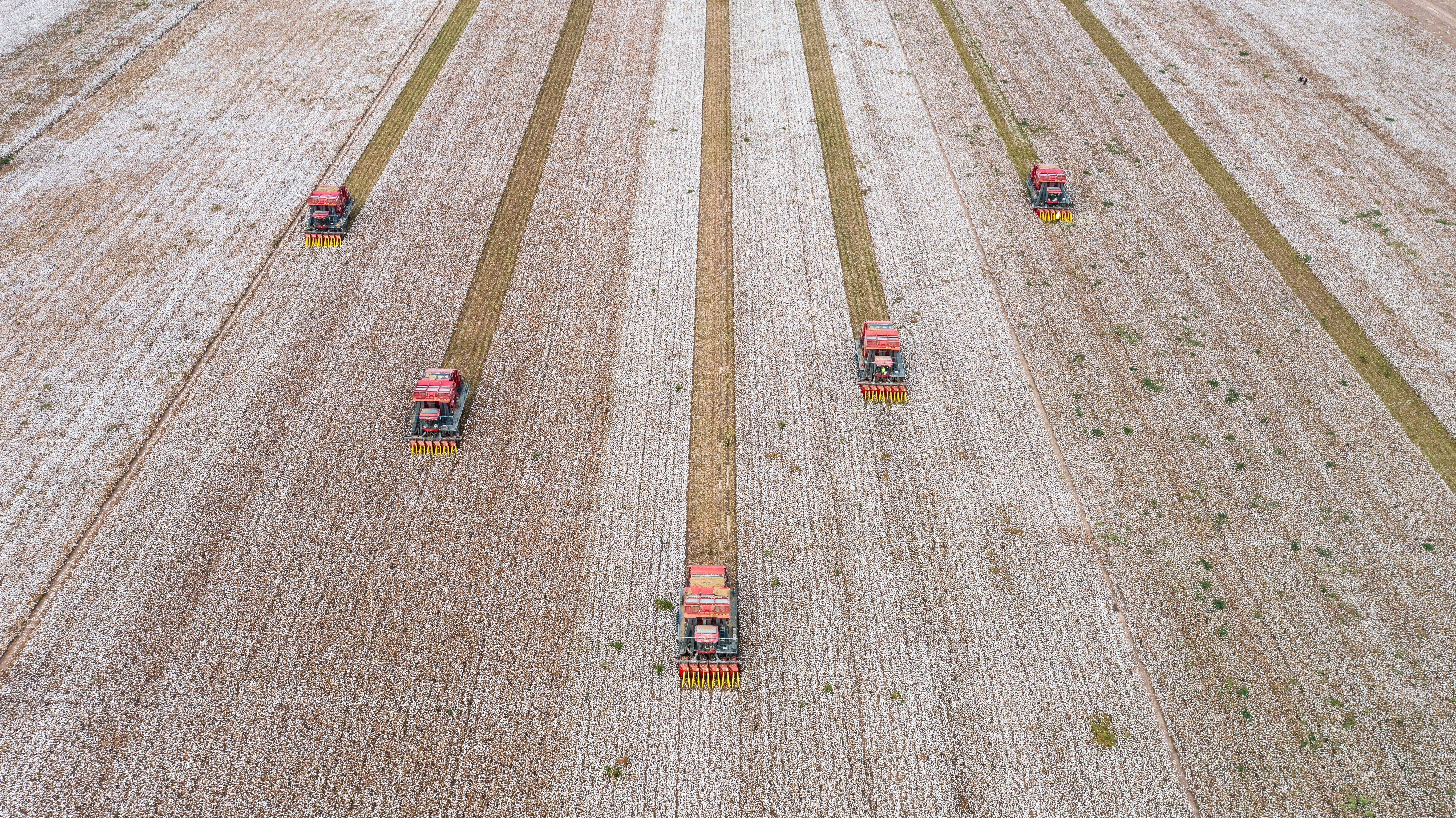
Today, a single six-row self-propelled cotton picker can harvest 33.33 hectares of cotton in a day—the equivalent of about 1,000 people working a full day. “I grow more than 126.67 hectares of cotton, and it’s all harvested in less than a week. My annual income is over a million yuan, all thanks to the machines,” said Amaier Tu’erhong. His story reflects the experience of countless cotton farmers across Xinjiang.
Today, on both sides of the Tianshan Mountains, technology is profoundly transforming cotton fields and production methods.
In Jimsar county, Changji Hui autonomous prefecture, seeders equipped with the Beidou Navigation Satellite System move slowly through the fields, completing tasks such as laying plastic film and precision seeding.
In Jiashi county, Kashi prefecture, each time a seeder passes, drip tape under the plastic film acts like capillaries, delivering water and nutrients directly to the roots of each cotton plant.
In Tumushuke city, as large cotton pickers move through the fields, snow-white lint is drawn into machines that harvest, compress and package simultaneously. A single machine can cover an average of more than 13.33 hectares per day.
Today, Xinjiang’s cotton industry supports the employment and livelihoods of more than 2 million people from various ethnic groups. More than 70% of cotton farmers in Xinjiang are from ethnic groups, and income from cotton cultivation is their primary source of earnings. Over 3,900 textile and garment companies are registered across Xinjiang, and the entire industry chain employs more than 1 million people.
This small cotton fiber is not only a shining symbol of Xinjiang’s vast land but also a tangible key to prosperity for local people of all ethnic groups. It bears witness to the region’s flourishing development and continues to write a new chapter in their pursuit of a better life.
The views do not necessarily reflect those of DeepChina.
Chief Editor/ Yang Xinhua
Editor/ Dong Mei
Translator/ Zhu Jianting
Related articles


Coordinator/ Yingge
Copyeditor/ Zhang Weiwei
Operation/ Tan Yujie
About DeepChina
DeepChina is an elite academic initiative that offers objective and rational analyses on a broad spectrum of topics related to China, encompassing politics, economics, culture, human rights, diplomacy, and geopolitics.