

Yan Xueqin
The success of Xinjiang's aquaculture has challenged the perception that only coastal regions can develop premium aquatic products. It demonstrates that by making the most of local resources and embracing new development concepts, inland border regions can build high-end modern industries.
When people think of Xinjiang, few associate it with modern fisheries. Yet today, salmon raised at the foot of the Tianshan Mountains is sold in high-end supermarkets in Beijing and Shanghai and exported to more than a dozen countries, including Singapore and the United Kingdom. From the barren Gobi Desert to abundant aquatic harvests, Xinjiang’s aquaculture industry has forged a distinctive path of modern development, offering a compelling example of high-quality development in China’s border regions and agricultural modernization.
From deep within the Tianshan Mountains to a world-renowned fishery
Rich in ice and snow resources yet far from the sea, Xinjiang’s fishery once remained largely out of the spotlight. In the 1950s, aquaculture in Xinjiang was virtually nonexistent, relying mainly on sporadic catches from natural waters. Constrained by a long freezing season, limited breeding technology, and inadequate storage and transportation infrastructure, the industry was characterized by a narrow range of species, small-scale operations, and insufficient local production. For decades, Xinjiang remained on the periphery of China’s aquaculture industry.
Over time, however, that picture changed dramatically. After decades of development, Xinjiang’s aquaculture industry has evolved from scattered household operations into a modern, fully integrated industrial chain.
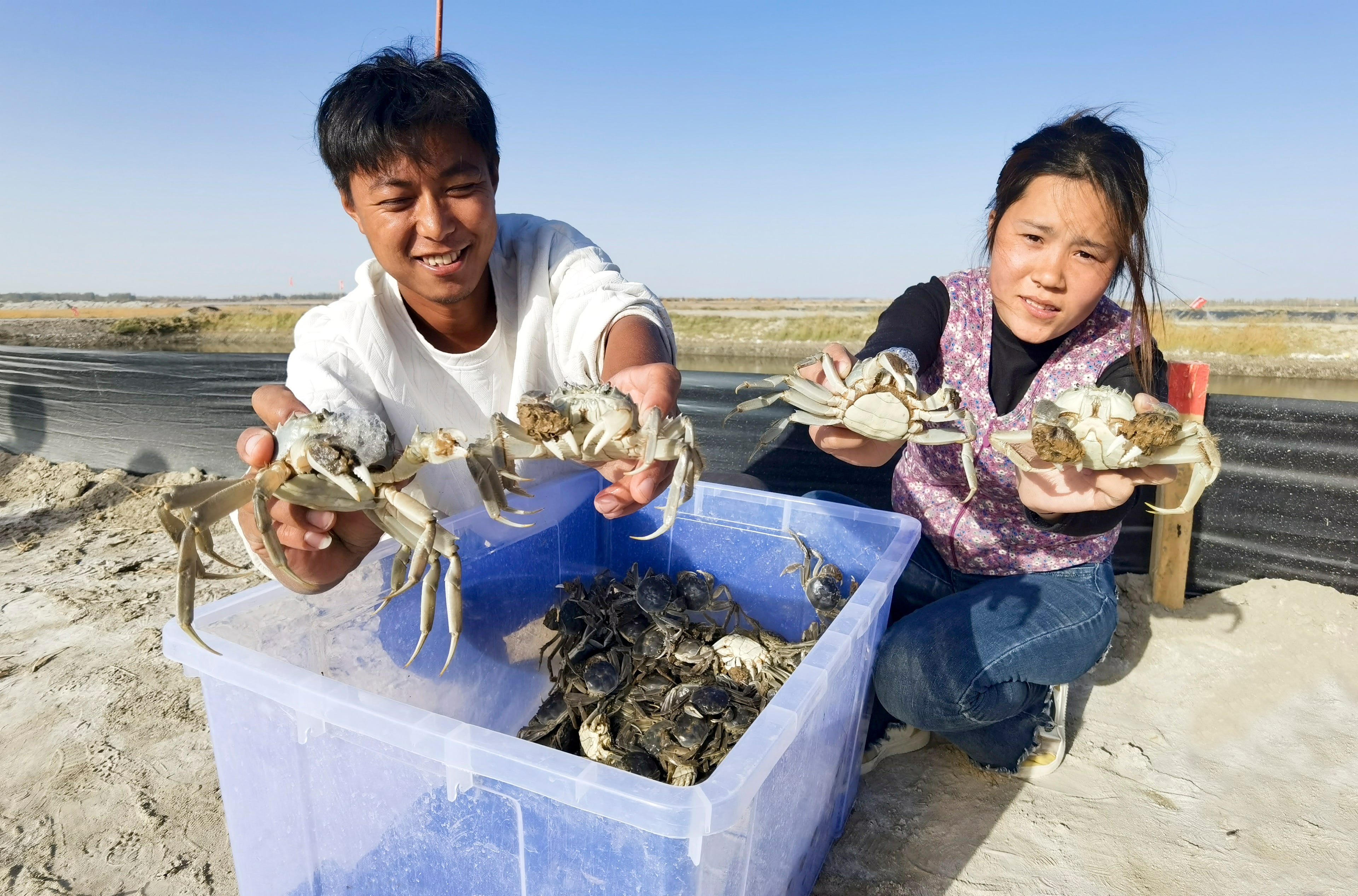
In terms of species, Xinjiang has long outgrown the perception that it produces only freshwater fish. Today, it raises not only common varieties such as grass carp, bighead carp, and silver carp to meet local demand, but also premium specialty products including rainbow trout (salmon), sturgeon, Chinese mitten crabs, Pacific white shrimp, and crayfish. Together, these have created a diversified industry in which traditional and high-value species develop side by side. At the same time, industrial growth has gone hand in hand with biodiversity conservation, with saline-alkali waters supporting both ecological restoration and aquaculture.
In terms of industrial layout, Xinjiang’s aquaculture industry is centered on cold-water fish farming in Ili, while saline-alkali aquaculture in southern Xinjiang has emerged as a new growth driver. The region’s total aquatic output ranks among the highest in northwest China.
In terms of market influence, Xinjiang’s salmon has gained nationwide recognition, selling well in China’s first-tier cities while also reaching international markets. In 2025, Ili’s annual salmon processing volume reached 8,000 tonnes, including 2,000 tonnes of deep-processed products. Certified under international programs including the Global Seafood Alliance’s Best Aquaculture Practices (BAP) and the BRC food safety certification, the products were exported to more than 10 countries and regions, including Singapore, Malaysia, the United Kingdom, and Russia. “Salmon from the Tianshan Mountains” has become a new hallmark of Xinjiang, attracting delegations from across China to study its experience and serving as a replicable model for developing specialty industries.
Inland frontier nurtures modern fisheries
Although Xinjiang, in China’s northwestern interior, is the provincial-level region farthest from the ocean, it has developed one of the country’s leading modern fisheries by forging a path tailored to its local conditions.
By moving from prioritizing grain production to embracing a broader vision of food security, Xinjiang has transformed its aquaculture industry through a fundamental shift in development philosophy. The region has moved beyond the traditional notion that “only farmland produces food and water bodies are idle resources,” instead recognizing fisheries as a strategic industry for food security and rural revitalization. It has therefore launched an initiative to “obtain high-quality protein from rivers, lakes and reservoirs” and incorporated it into its broader strategy alongside its role as a key national supply base for high-quality agricultural and livestock products.
Breeding capacity and technological innovation have advanced hand in hand. Leveraging east-west cooperation and pairing assistance programs, Xinjiang has addressed longstanding gaps in fish fingerlings, technology, and skilled personnel needed to develop modern fisheries. In partnership with national-level research institutions such as the Chinese Academy of Fishery Sciences, it has established standardized cold-water fish breeding bases in the Ili River valley and other areas, with annual fry hatching capacity reaching tens of millions, fundamentally ending reliance on imported cold-water fish fingerlings. Through its pairing assistance program, Jiangsu province has continuously supported Qapqal Xibe Autonomous County in Ili Kazak Autonomous Prefecture by helping it introduce high-quality species such as the “Yangtze No. 2” Chinese mitten crab and inviting experts from national research institutions to provide long-term technical support in the county. Over the years, Xinjiang has introduced a variety of specialty species, including Chinese mitten crabs, Pacific white shrimp, rainbow trout, and sturgeon, steadily enriching its breeding resources. Today, this cooperation has evolved from one-way technology transfer into two-way expertise exchange, with Xinjiang’s modern cold-water fish farming model now serving as a reference for other provinces, demonstrating the benefits of mutually beneficial collaboration.
Technology-driven innovation has further upgraded the industry. Xinjiang has promoted the development of its fishery sector by using technological innovation to overcome key bottlenecks. It achieved a major breakthrough in breeding rare species: In 2020, researchers first succeeded in artificially breeding the critically endangered thorn sturgeon (Acipenser nudiventris). Large-scale breeding and release followed in 2024, and by 2025, more than 50,000 healthy fry had been released. With only 11 wild thorn sturgeon known to remain in China, these ongoing artificial breeding and stock enhancement efforts are critical to the species’ conservation and recovery.
At the same time, Xinjiang has advanced smart ecological aquaculture by establishing intelligent cold-water salmon farming bases. Leading enterprises have obtained 48 utility model patents related to salmon farming and processing. Their self-developed intelligent, environmentally friendly cage farming systems thoroughly remove farming waste while shortening the salmon growth cycle from 36 months to 26 months. In addition, the country’s first online upstream-downstream water quality monitoring system enables full-process ecological management. Xinjiang has also pioneered the use of blockchain technology for aquatic product traceability, giving salmon a “digital identity” that enables full traceability from fry to table, significantly strengthening consumer confidence and brand value.
By actively integrating into China’s unified market and the global supply chain, Xinjiang has expanded new opportunities for industry growth. It develops brands in response to market demand, supports leading enterprises in producing higher-value products such as collagen peptide beverages and health foods, and improves quality by aligning with international standards and pursuing global certifications, enabling its products to enter the international seafood supply chain. Leveraging its geographic position as China’s gateway to the west, Xinjiang exports aquatic products to Central Asia and Europe, with growing advantages in both delivery times and logistics costs. Today, Xinjiang’s aquatic products are sold throughout China and overseas, making the region a standout example of high-quality inland fishery development.
The model of rural prosperity through industrial development paints a new picture of common prosperity
Drawing on its high-quality environment and abundant premium aquatic products, Xinjiang’s aquaculture industry has not only enriched dining tables across China but also brought profound changes to the region. It has become a key driver of common prosperity among the ethnic groups in the region and an important force for rural revitalization.
The aquaculture industry has created substantial, stable employment while steadily raising incomes for farmers and herders. In Ili alone, the sector provides stable employment for 800 people each year, with frontline workers at leading enterprises earning more than 6,000 yuan a month. It has also stimulated growth in logistics, catering, tourism, and other related industries, creating more than 500 additional jobs. During the critical stage of poverty alleviation, leading enterprises adopted a model combining enterprise leadership, park-based employment, and social security, distributing a total of 7.308 million yuan in dividends to 609 formerly impoverished households. Many herders who once followed their livestock across the grasslands have become employees at modern aquaculture bases, shifting from livelihoods dependent on natural conditions to stable and steadily increasing incomes. At aquaculture bases on the edge of the deserts of southern Xinjiang, annual household incomes have commonly increased by tens of thousands of yuan, making the industry a reliable source of prosperity for local farmers and herders.
The industry has diversified rural economic activities while driving industrial upgrading. In the past, Xinjiang’s rural economy relied largely on crop cultivation and animal husbandry, with limited industrial diversity and relatively low added value. The growth of aquaculture has stimulated breeding, deep processing, cold-chain logistics, and recreational fishing, while promoting integration across the primary, secondary, and tertiary sectors. “Aquaculture plus processing” extends the value chain from selling raw products to marketing finished goods, while “aquaculture plus tourism” has fostered leisure activities such as recreational fishing, sightseeing, and farm-stay experiences, attracting growing numbers of visitors and creating new engines of rural economic growth. As a result, the industry’s resilience and profitability have improved significantly, positioning aquaculture as an important pillar of rural revitalization.
The aquaculture industry has pioneered a path that balances ecological protection with economic development, offering a new model for industrial modernization in border regions. By consistently prioritizing ecological conservation and green development, Xinjiang has protected aquatic ecosystems and restored endangered species while expanding its aquaculture industry, transforming saline-alkali land into productive resources with both ecological and economic value. More importantly, the success of Xinjiang’s aquaculture has challenged the perception that only coastal regions can develop premium aquatic products or that border regions are limited to traditional industries. It demonstrates that by making the most of local resources and embracing new development concepts, inland border regions can build high-end modern industries and integrate into global markets, providing a vivid example of Chinese modernization in border areas.
The story of Xinjiang’s aquaculture is a microcosm of Chinese modernization. Modernization does not follow a single fixed model — even remote inland border regions can forge their own paths to high-quality development. From the cold waters of the Tianshan Mountains producing world-renowned salmon to saline-alkali waters in the desert generating new sources of prosperity for farmers and herders, Xinjiang’s distinctive development journey highlights the vitality and potential of China’s border regions while offering valuable experience for Chinese modernization.
The views do not necessarily reflect those of DeepChina.
The author is Yan Xueqin, deputy dean and associate professor at the School of History and Society at Xinjiang Normal University.
Chief Editor/ Yang Xinhua
Editor/ Dong Mei
Translator/ Wang Li
Related articles


Coordinator/ Yingge
Copyeditor/ Zhang Weiwei
About DeepChina
DeepChina is an elite academic initiative that offers objective and rational analyses on a broad spectrum of topics related to China, encompassing politics, economics, culture, human rights, diplomacy, and geopolitics.